
Welding is a craft that turns raw metal into functional art, and it’s more accessible than ever. Whether you want to repair tools, build furniture, or start a hobby, knowing the best welding for beginners will set you on the right path. In this guide, we’ll walk through the essential tools, safety practices, and techniques that make learning to weld enjoyable and effective.
We’ll cover how to choose the right welder, the most beginner-friendly welding processes, and top tips for getting clean, strong welds. By the end, you’ll have a clear roadmap to start welding with confidence.
Choosing the Right Welder for New Welders
When you’re new to welding, your first purchase is the most important. It should be affordable, easy to use, and versatile enough to grow with you. Below are the three most popular beginner-friendly welder types.
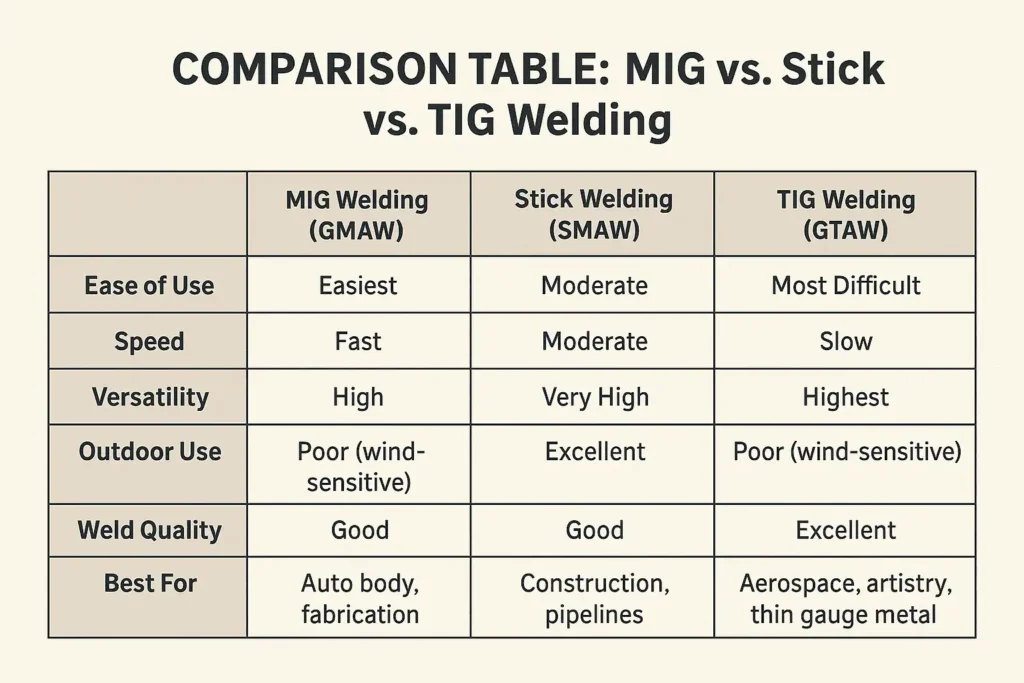
MIG Welding (GMAW)
Metal Inert Gas welding, or MIG, is often called the “starter’s choice.” It uses a continuously fed wire and a shielding gas that protects the weld pool. MIG welders are user-friendly, produce smooth beads, and allow you to focus on technique rather than complex settings.
TIG Welding (GTAW)
TIG is more precise and produces high-quality welds, but it demands steady hands and great coordination. If you’re willing to practice, TIG offers excellent control over the weld pool and is ideal for thin metals.
Stick Welding (SMAW)
Stick welding is durable and works well outdoors or on rusty metal. It’s a good choice if you prefer a traditional arc welder that’s less reliant on gases.
For most beginners, a portable MIG welder offers the best balance of cost, ease, and versatility. Look for units that are under 100 A and come with a safety interlock switch.
Key Features to Check
- Current rating (amps) suitable for the material thickness.
- Auto-adjusting duty cycle for consistent performance.
- Built-in safety interlock and temperature control.
- Compact size for easy storage.
Essential Safety Gear and Workspace Setup
Welding produces intense heat, bright light, and sharp metal edges. Proper safety gear protects you and your equipment.
Personal Protective Equipment (PPE)
Don’t skimp on safety. At minimum, you need:
- Heat-resistant welding jacket
- Gloves rated for welding temperatures
- Safety glasses or a welding helmet with a dark shade
- Steel-toe boots and ear protection if you’re in a noisy garage
Always check that your gear meets industry standards like ANSI/ISEA 107.
Workstation Layout
Organize your space so that everything is within reach but clear of hazards. Keep a fire extinguisher nearby, and avoid storing flammable materials within 10 ft of the welder.
Ventilation and Dust Control
Welding fumes can be harmful. Use a local exhaust hood or ensure your workspace has good airflow. A respirator is recommended if you weld in a poorly ventilated area.
Grounding and Electrical Safety
Always inspect the grounding clamp for corrosion. Use a dedicated circuit if possible, and never overload outlets.
Mastering the Basics: Welding Techniques for Beginners
With the right equipment and safety gear, you can focus on the fundamentals of welding. Below is a step-by-step guide to help you practice effectively.
Setting Up the Welder
Before you touch the metal, set your welder to the recommended amperage for the material thickness. Use the manual to find the correct setting.
Proper Hold and Angle
Hold the welding torch at a 10–15° angle from vertical. Keep a steady hand and maintain a 2–4 inch distance from the workpiece.
Travel Speed and Consistency
Practice a consistent travel speed. Moving too fast creates weak welds; moving too slow may cause burn-through. Aim for a steady, even bead.
Backstepping and Weld Inspection
After finishing a weld, step back to inspect the bead. Look for cracks, porosity, or unevenness. Adjust settings if necessary.
Practice Projects
Begin with simple tasks: a 2×2 square frame, a small hinge, or a welded plate. Gradually tackle more complex shapes as confidence grows.
Top 5 Beginner-Friendly Welding Projects
Hands-on projects reinforce learning and build a portfolio of work. Here are five projects that beginners can tackle.
1. Welded Tool Crib
Build a sturdy frame to store wrenches or hand tools. Use 1/4” steel tubes and simple butt joints.
2. Metal Garden Bench
Craft a small garden bench using steel angles. This project introduces bevel joints.
3. Decorative Metal Wall Art
Create a collage of welded shapes. This is great for practicing filler material and bead control.
4. Simple Pipe Frame
Weld a 6-foot pole frame with 1/2” pipe. This teaches how to handle larger pieces.
5. Custom Light Fixture
Fabricate a metal lamp base. This combines welding with hand finishing and polishing.
Comparison Table: MIG vs. TIG vs. Stick for Beginners
| Aspect | MIG | TIG | Stick |
|---|---|---|---|
| Learning Curve | Easy | Intermediate | Easy |
| Cost (Starter Kit) | $200–$400 | $300–$600 | $150–$300 |
| Best for | All‑metal, thick plates | Thin metal, precision | Rusty or outdoor work |
| Safety Gear Needed | Standard PPE | Standard PPE | Standard PPE |
| Ease of Setup | Very Easy | Requires setup | Very Easy |
Pro Tips: Advanced Techniques to Accelerate Learning
- Use a welding simulator before hitting real metal. Software can give instant feedback on technique.
- Record your sessions to spot mistakes you can’t see in real time.
- Maintain a clean work area to avoid contaminants that cause weld defects.
- Practice on scrap metal first; it saves time and protects expensive parts.
- Learn basic metal geometry; knowing angles helps with joint preparation.
Frequently Asked Questions about best welding for beginners
What is the best type of welding for a beginner?
Most beginners start with MIG welding because it’s intuitive, produces smooth beads, and works well on a variety of metals.
Do I need a special vacuum chamber for welding?
No. For most hobby projects, a well-ventilated space with a local exhaust hood suffices.
How much does a beginner welder kit cost?
A basic MIG kit ranges from $150 to $400, while TIG kits start around $300 and can go up to $700.
Is welding dangerous for beginners?
Like any metalworking process, welding has risks. Proper PPE, ventilation, and safety practices mitigate these hazards.
Can I weld on aluminum with a MIG welder?
Yes, but you need a MIG welder that supports aluminum and a special aluminum flux core wire.
How long does it take to become proficient at welding?
Consistent practice over 6–12 months can yield competent skills, though mastery may take years.
What are common welding defects beginners should watch for?
Porosity, undercut, weld bead cracking, and slag inclusion are typical issues that can be corrected with practice.
Do I need a separate room for welding?
Not necessarily, but a dedicated, well-ventilated area helps keep fumes away from living spaces.
Can I use a corded or cordless welder?
Both are viable; corded offers consistent power, while cordless provides mobility.
What additional tools are useful for beginners?
Clamps, a grinding wheel, a metal sander, and a heat-resistant workbench are essential accessories.
Learning to weld is a rewarding skill that combines creativity with technical precision. By selecting the right equipment, prioritizing safety, and practicing consistently, you’ll quickly see progress and feel confident tackling more complex projects.
Ready to turn your metal ideas into reality? Grab a beginner-friendly MIG welder, set up your workspace, and start welding today. The possibilities are only limited by your imagination—and your skill.

